
![[PKU 2026] Tychonoff Theorem](/_astro/banner.CqMKXFu6_Z1SX1wc.webp)

Peking University Stuffs
Problem
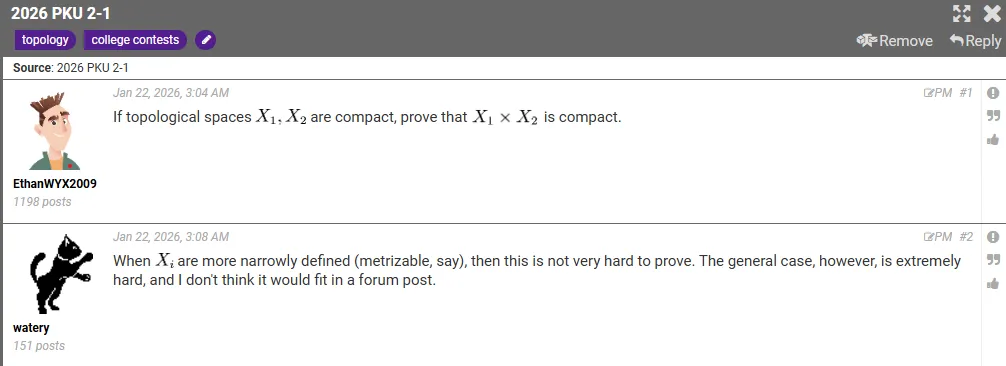
If topological spaces and are compact, Prove that is compact.
I encountered this challenge while I was browsing through the AoPS forum. It caught my attention that @watery replied in that thread about why it is hard to prove. This got me thinking, because that’s exactly what the Tube Lemma is used to prove. So I started trying to solve this problem from Peking University (PKU) lol!!
This was the response I gave,
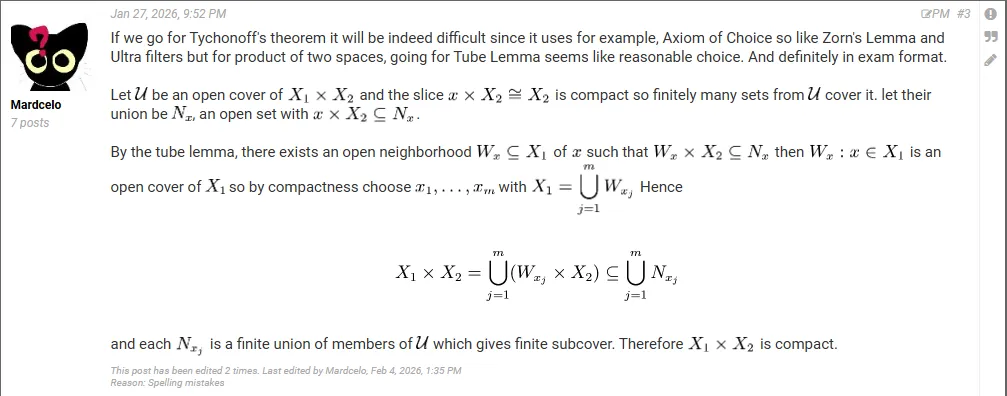
Well here’s much formal version of that, which i actually took more time and effort on writing.
Lemma (Tube Lemma)
Let be any space and be compact. If is open and , then there exists an open neighborhood of such that .
Proof
Let be an open cover of .
Fix . The slice is homeomorphic to , hence compact. So there exist
such that
Define the open set
Then , and is open in .
By the Tube Lemma (with ), there is an open neighborhood of such that
Now is an open cover of because is compact, so we can choose
Each is a finite union of members of , so is a finite union of members of . Because of this has a finite subcover.
So we just proved that is compact!
Note that this proof is elementary. Since you learn the Tube Lemma early in Topology, the logic doesn’t quite extend to the arbitrary infinite product case. To handle that extension, we’ll introduce ‘equivalent’ definitions of compactness later in the post :)
Note that at some point, we’ll use some elementary cardinal arithmetic.
Introduction to Tychonoff Theorem
Before we get our hands dirty and all those math signs, I will tell you a bit about Tychonoff Theorem, actually lemme make this boring but cool by bringing what Wikipedia told me.
Tychonoff’s theorem states that the product of any collection of compact topological spaces is compact with respect of the product topology. the theorem is named after Andrey Tikhonov (aka. Tychonoff). Who proved it first in 1930 for powers of the closed unit interval and in 1935 states the full theorem along with the remark that its proof was the same as for the special case. The earliest known published proof is contained in a 1935 article by Tychonoff, “Über einen Funktionenraum”
Well this is important because Tychonoff’s theorem is one of the most foundational theorem in topology. And this is also goes for topological spaces that is based on uncertain sets (Sets whose elements have degrees of membership).
That didn’t really showed how important it is right? So lemme give you a scenario.
If we take an infinite product of spaces, the box Topology seems intuitive but it destroy the compactness (This will be important later on).
So what’s the solution? Tychonoff’s theorem. The Tychonoff’s theorem confirms that the Tychonoff topology is the “correct” topology to use since it is the only topology that can render the product of compact spaces compact (you know what i mean) This will validate the definition of the product topology itself.
Aaand also Tychonoff’s theorem is also used to prove the Banach-Alaoglu Theorem.
Bradley University’s “Junior Tychonoff” proof
There’s very standard proof “textbook” style such as Munkres or Kelly which goes for definition of compactness (open covers) directly without considering convergence.
While standard proofs often rely on covers and sub bases, the filter based approach goes a a bit more “elegant” approach (Honestly both of them are cursed still). This was done by treating points and “directions” of convergence algebraically via filters, the proof of the product theorem reduces to a co ordinate wise verification.
Sounds cool right? Let’s do it!
This is assignment from Bradley University I found when I was searching about Tychonoff. And I think it was worth mentioning so here it is.
What Bradley University is doing is basically the tube lemma we did above, but they built the tube by hand using basic opens
Any open cover of can be refined by a cover consisting of basic rectangles with , and $V\subseteq opened because those rectangles form a basis for the product topology.
Theorem (Junior Tychonoff)
If and are compact, then every open cover of by basis rectangles has a finite subcover.
Proof
Let be an open cover of by basis rectangles .
Fix . The slice is homeomorphic to , hence compact. So choose finitely many rectangles
that cover .
Since each is an open neighborhood of , the intersection
is open in and still contains
Now check the “tube” inclusion
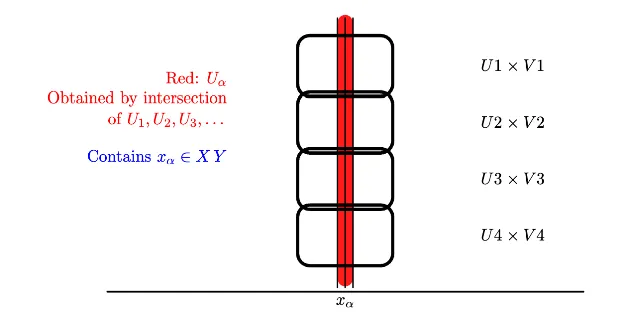
Why?
For instance, take any Since is covered by the rectangles, we can choose such that
For example
Hence
So is an open cover of . Compactness of gives such that
Then
which is a finite union of rectangles from !
Why the infinite product case is genuinely different
For a finite product, you can basically “thicken a slice” in one coordinate and boom, you are done.
For an infinite product this kind of thickening becomes subtler since a basic open set only restricts finitely many coordinates, and compactness interacts with that finiteness in an essential way.
This is also where the box topology vs product topology split shows up, In the box topology, you allow all coordinates to be restricted at once since products of opens with no finiteness condition but in other hand for the product topology, only finitely many coordinates are restricted in a basic neighborhood.
Tychonoff’s theorem talks about that the compactness is possible in the product topology, but in general sense, it fails for the box topology on infinite products.
Filters, ultrafilters, and compactness
To go full Tychonoff, I’ll use the ultrafilter characteristics of compactness.
Now you will ask me what is filters, ultrafilters, and compactness. Great question But i’m kinda lazy for now, so I will maybe make a new blog post about this.
For some disclaimer, I’ll use
- for an open cover
- for an ultrafilter
Definition 4.1 (Filter)
Let be a set. A nonempty collection is a filter if
- Upward closed if and , then
- Finite intersection if , then
Definition 4.2 (Ultrafilter)
A filter on is an ultrafilter if it is maximal among filters (aka. not properly contained in any other filter) Equivalently for every , either or
Definition 4.3 (Filter convergence)
Let be a topological space and a filter on . We say converges to written if every open neighborhood of belongs to
Proposition 4.4 (Ultrafilter characterization of compactness)
A topological space is compact if every ultrafilter on converges to at least one point of .
Proof
() Assume is compact and let be an ultrafilter on .
If converges nowhere, then for each there is an open neighborhood with .
Since is an ultrafilter it’s for each .
But is an open cover so choose a finite subcover .
By closure under finite intersections, the left side would belong to This contradicts . Hence converges somewhere.
() Assume every ultrafilter converges. Let be a family of closed sets with the Finite Intersection Property (FIP). The family of all finite intersections of the ’s forms a filter base so it generates a filter . By the Ultrafilter Lemma (a form of Choice) we can extend to an ultrafilter By assumption for some .
Since , every belongs to . Suppose . Then is an open neighborhood of , so convergence implies . By finite intersection, we get
which is impossible. Thus for all , meaning . This proves compactness.
Filters on products
Definition 5.1 (image filter)
Let be a function and a filter on . Define the pushforward filter
Then is a filter on . If is an ultrafilter, then is an ultrafilter on
The next lemma is the whole reason filters make Tychonoff feel “coordinatewise”.
Lemma 5.2 (Convergence in a product is coordinatewise)
Let be spaces and with the product topology. Let be the projections. A filter on converges to iff for every ,
Proof
() The projection is continuous. Kinda standard fact but if and is continuous, then . Apply it with
() Assume for all .
Let be a basic open neighborhood of in the product topology.
where each is open in and because of
we have
By definition of pushforward, this means . Filters are closed under finite intersections, so .
Hence .
Tychonoff’s Theorem
Theorem 6.1 (Tychonoff)
Let be a nonempty family of compact topological spaces. Then the product
is compact in the product topology.
Proof
Let be an ultrafilter on . We will show converges.
Fix . Consider the pushforward ultrafilter on . Since is compact, Proposition 4.4 implies converges to some point .
Do this for every , and define by the coordinates . Then for each ,
By Lemma 5.2, this implies in .
So every ultrafilter on converges; by Proposition 4.4, is compact.
It was quite a journey right?? Well for me it was, took me a while writing this. But I’m happy that I was able to finish this off. This was one of the “TODO” on my list lol.
Summary
Honestly, While i was searching through some tube lemma related resources, I was quite surprised on my findings that even in the nLab had typo on Tychonoff, I feel bad for Andrey Tikhonov (Also known as Tychonoff) that had his name typo’ed in a lot of places. So I fixed it while in doing it :)
But while I was writing i was asking “what if… we go for full proof for Tychonoff theorem like Watery was suggesting..”, But I was like nahhhh Imma LET IT ROLL lol
Q: why make life harder? A: I have so much free time and i have no idea on new blog topic.
References
These were the reference I also used besides nLab.
- Munkres, Topology
- Willard, General Topology
- Kelley, General Topology